Adding Downlights to Your Inner West Terrace? What Ceiling Insulation Means for Your Lighting Circuit
Can you just add downlights into an old Inner West terrace ceiling once insulation goes in? Only if the fittings and the installation method actually suit having insulation nearby. AS/NZS 3000 sets strict clearance and classification rules for recessed lighting near thermal insulation, and getting this wrong is a genuine, well documented house fire risk, not just a paperwork technicality.
1. Why Ceiling Insulation Changes What Downlights Are Allowed
A recessed downlight generates heat that needs somewhere to go. AS/NZS 3000 Clause 4.5.2.3.1 requires every recessed luminaire to be installed so it cannot overheat or ignite nearby combustible materials, and bulk thermal insulation sitting over the back of a downlight is exactly the kind of material that can trap that heat. The fix is not a single rule, it is a choice between a few compliant methods: a luminaire certified by its manufacturer as suitable for contact with insulation, a luminaire paired with a barrier tested to AS/NZS 5110, or a luminaire kept clear of insulation by set minimum clearances.
This matters more in an older Inner West terrace or semi than in a new build, simply because so many of these homes have had insulation added well after the original downlights went in, often during a separate energy efficiency upgrade that had nothing to do with the electrical work at all.
2. The Five Downlight Classifications (and the Ones Banned in Australian Homes)
AS/NZS 60598.2.2 sets out five recessed luminaire classifications, each marked with its own symbol: Non-IC, Do-not-cover, CA90, IC and IC-4. A Non-IC fitting cannot be abutted against or covered by insulation or combustible material at all, and under AS/NZS 3000 Clause 4.5.2.3.5, Non-IC luminaires must not be installed in residential installations in Australia. In Australian homes, only Do-not-cover, CA90, IC or IC-4 luminaires are permitted, and only IC and IC-4 fittings are actually designed to be buried under insulation in normal use. A CA90 fitting can have insulation up against its sides but not resting on top, while a Do-not-cover fitting needs clearance on every side.
3. What Happens When You Retrofit Insulation Over Existing Downlights
Clause 4.5.2.3.3 is specific about retrofits: where insulation already exists and downlights are added later, or where insulation is added over downlights that are already there, precautions have to be taken so the safety of the installation is not compromised. An unmarked light fitting, which describes a lot of older downlights still in service, is treated as Do-not-cover by default, meaning a barrier or a set clearance has to be maintained around it rather than assuming it is fine to cover.
The default clearances where no manufacturer figure is available are set out in the standard's own diagram: at least 100mm above the fitting to any building element, 100mm to the side of any building element or insulation, and 50mm to the side of any control gear. Where loose insulation is present rather than insulation that is properly secured in position, a fixed guard is required regardless of these clearances.
4. The Warning Sign Rule for Roof Spaces
Clause 4.5.2.3.2 requires a permanent, legible warning sign in any accessible roof space containing recessed luminaires, mounted near the access point so it is visible to anyone entering the space. The sign has to carry specific wording warning against covering the fittings with insulation or other material unless the manufacturer or barrier instructions allow it. The one exception is where every recessed luminaire in that roof space is IC or IC-4 classified, in which case the sign is not required, since those fittings are designed to handle being covered in the first place.
5. Why Older Inner West Terraces Are a Common Case for This
Plenty of Federation and Californian bungalow homes across Balmain, Leichhardt, Petersham, Stanmore and Dulwich Hill have had downlights added over the decades without anyone tracking which classification went in where, a pattern we cover in more depth in our guide to original wiring in Federation and Californian bungalow homes. A heritage listed property brings its own extra layer of consideration too, which our heritage electrical work guide covers in detail. When a renovation finally adds proper ceiling insulation to one of these homes for the first time, often alongside a switchboard upgrade, it is the moment every existing downlight in that ceiling actually needs to be checked, not assumed safe.
6. Safety Switches on Every Lighting Circuit
Lighting circuits are not exempt from safety switch requirements. Every final subcircuit in a domestic or residential installation, lighting points included, needs additional protection by an RCD with a maximum rated residual current of 30mA, fitted at the switchboard where that circuit originates. Where a switchboard is fully replaced or an existing lighting circuit is altered, that protection has to be added at the same time, which is another reason a lighting and insulation check so often rides along with broader switchboard work rather than happening on its own.
7. Lighting in Shared Inner West Apartment Buildings
Walk-up blocks and strata buildings carry an extra requirement: external lighting installations in common areas of multiple residential buildings need their own RCD protection, separate from what covers each individual unit. We go into the broader shared supply picture for this kind of building in our guide to electrical work in older walk-up apartment blocks, and the same common property versus lot responsibility questions that apply to a strata switchboard upgrade apply just as much to shared stairwell, car park or courtyard lighting.
How High Demand Electrical Helps
High Demand Electrical is a licensed local team, not a call centre, and we check downlight classification against ceiling insulation as standard whenever we are already working in an Inner West roof space, not just when a lighting job is the reason we are called out. If you are after lighting design and installation near you in the Inner West, whether that is a straightforward downlight upgrade or planning the lighting layout for a full terrace renovation, our team matches the fittings to what your ceiling can actually take, fits the required RCD protection, and leaves the roof space correctly signed if any non IC rated fittings remain.
Downlight and Ceiling Insulation FAQs (Sydney)
Can I add ceiling insulation myself if I already have downlights?
Only if you know the classification of every downlight already installed and keep the correct clearances or barriers in place. An unmarked fitting has to be treated as Do-not-cover, which rules out simply laying insulation straight over the top.
How do I know what classification my existing downlights are?
Check the fitting itself for a Non-IC, Do-not-cover, CA90, IC or IC-4 symbol. If there is no visible marking, AS/NZS 3000 requires it to be treated as Do-not-cover regardless of what it might actually be.
Is this actually a fire risk, or just a compliance box to tick?
It is a genuine fire risk. Insulation sitting against a fitting that cannot dissipate heat properly can allow nearby timber and other combustible material to reach ignition temperature over time, which is exactly why the standard treats it as a safety clause rather than a formality.
Do I need a new safety switch if I am only adding a few downlights?
If you are adding to an existing final subcircuit, any new socket outlets on that circuit need RCD protection from the point the new wiring starts, and a full switchboard replacement triggers RCD protection across every circuit it serves. See our switchboard upgrades service for how this is usually bundled into one job.
Does this apply to outdoor or alfresco downlights too?
Yes, the same classification and clearance rules apply to any recessed luminaire, indoor or outdoor, and common area outdoor lighting in a strata building carries its own separate RCD requirement again.
Get Your Inner West Lighting Checked Properly
If you are renovating, adding ceiling insulation, or simply want your existing downlights checked against today's rules, our Lighting Design and Installation service covers exactly this. Call 0402 559 777 to book a site assessment. Every job needs an on site look before scope and pricing can be confirmed, since the existing fittings, roof space access and insulation type all affect what is actually required.
If your terrace is fed by a rear lane private pole, the same older housing stock questions often come up together. See our sister site's guide to private power pole ownership and rules for that side of an older Inner West property, and the main site's electrical safety inspection service for a full property wide check.
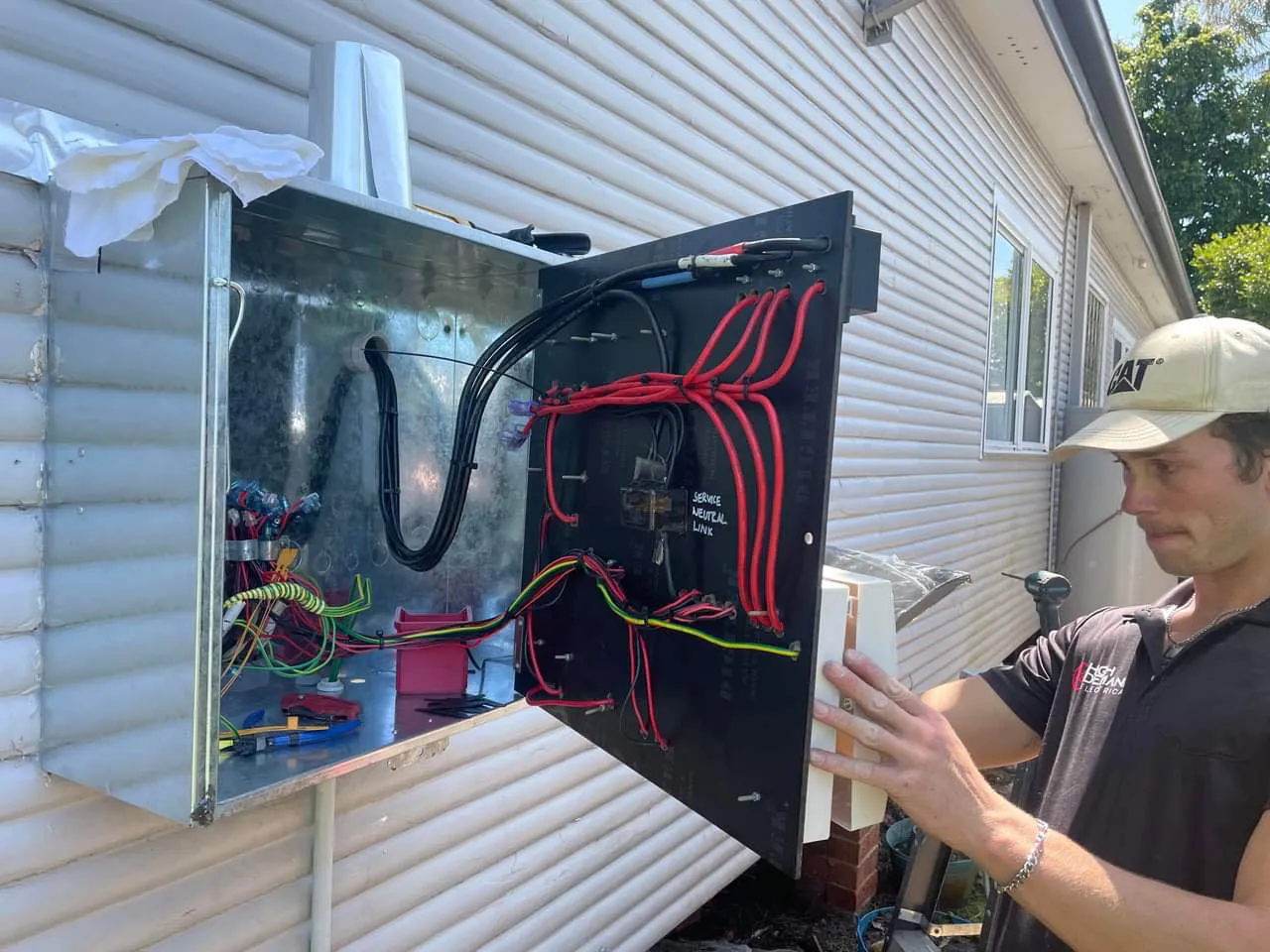
Powering Your Needs with Expertise
If you want a reliable, experienced, and prompt electrician, High Demand Electrical is the one to call. We cover every electrical need — routine maintenance, emergency repairs, full system installs — and our team is focused on keeping your setup running smoothly. Small task or big project, give us a ring today.
