Where Can the Meter Box Actually Go on an Inner West Terrace?
Where can the meter box actually go on an Inner West terrace? The Service and Installation Rules of NSW give a single dwelling four approved locations: the wall facing the front boundary, an adjoining side wall close to that front corner, a private pole, or inside the front boundary fence. For narrow Inner West terraces with no side access and heritage streetscapes to work around, fitting a compliant meter box into that short list is often the real challenge, not the electrical work itself.
⚡ Quick Answers: Meter Box Placement on an Inner West Terrace
- Where is the meter box allowed to go on a standard terrace? On the front facing wall, an adjoining side wall within 1.5m of that front corner, a private pole, or within the front boundary fence.
- Can the meter box sit behind a locked front gate? Yes, provided the gate has a standard distributor locking facility fitted so the meter reader and any attending electrician can get in.
- Can it go inside the hallway near the stairs? No. Narrow passageways, confined spaces and anywhere over a stairway are specifically banned locations.
- What if my terrace has no side access at all? The front facing wall or the front boundary fence are both valid fallback locations when there is no usable side wall.
- Does an old asbestos meter panel need replacing when the box moves? Yes. A new meter panel must be asbestos free, and relocating the box is the natural trigger to replace an old bakelite or fibro panel.
- Who actually decides the final position, me or the distributor? You and your electrician choose from the approved options, but the final position is confirmed with the Metering Coordinator.
1. The Four Approved Locations for a Standard Terrace
For a single domestic premises, the Service and Installation Rules of NSW set out exactly four places service equipment, meaning your meter box and its associated fuse, is allowed to sit, and all four assume ready pedestrian access is maintained:
- On the face of the house facing the front boundary.
- On the adjacent side wall, within 1.5m of that front face, or an associated corner window or verandah.
- On a private pole, where one exists. For a pole fed property instead of a standard street connection, the same question is answered from the private pole side in HD Power Pole's guide to meter and service equipment location on a private power pole.
- Within the front boundary fence, provided isolation and maintenance can be carried out safely.
Where the main entrance to the terrace is actually on the side rather than the front, the rules allow the meter box on that side wall instead, as long as it sits no more than 1.5m beyond the entrance and access remains available. This matters more than it sounds on an Inner West terrace, where the front door and the genuinely used entrance are not always the same thing once a rear lane or a side return has become the practical way in.
2. Why a Locked Front Gate Is Not Automatically a Problem
Plenty of Inner West terraces, particularly around Balmain, Rozelle, Glebe and Annandale, have a front fence with a locked gate as standard, whether for security or simply because that is how the street was built. A locked gate in front of the meter box is not disqualifying on its own. What the rules require is a standard distributor locking facility fitted to that gate, so a meter reader or attending electrician can get in using the same key system used across the network, rather than needing your personal key or a call ahead. If your gate currently has an ordinary padlock or a smart lock with no distributor access, that is the detail worth fixing before, not after, a meter box relocation.
3. The Places Your Meter Box Is Never Allowed to Go
Alongside the four approved spots, there is a specific list of locations service equipment can never go, regardless of how convenient they would be:
- Over stairways or ramps, in narrow passageways, or in confined spaces, which rules out most terrace entrance halls where the stairs to the upper floor start just inside the front door.
- In vehicle docks, driveways or passageways where the equipment, or someone working on it, would not be properly protected.
- In close proximity to, or above, machinery or open type switchgear.
- Anywhere affected by fumes, vibration, dampness or dust that could degrade the equipment or make it unsafe to work on.
- Inside a swimming pool zone, directly in the sun with no shelter, near an LPG cylinder, or anywhere that needs a ladder to reach.
For a typical terrace, the stairway and confined space rule is the one that actually bites. It is a common instinct to want the meter box tucked inside the entry hall out of sight, and it is one of the first ideas a compliant installer has to rule out.
4. What a Proper Meter Panel Upgrade Actually Involves
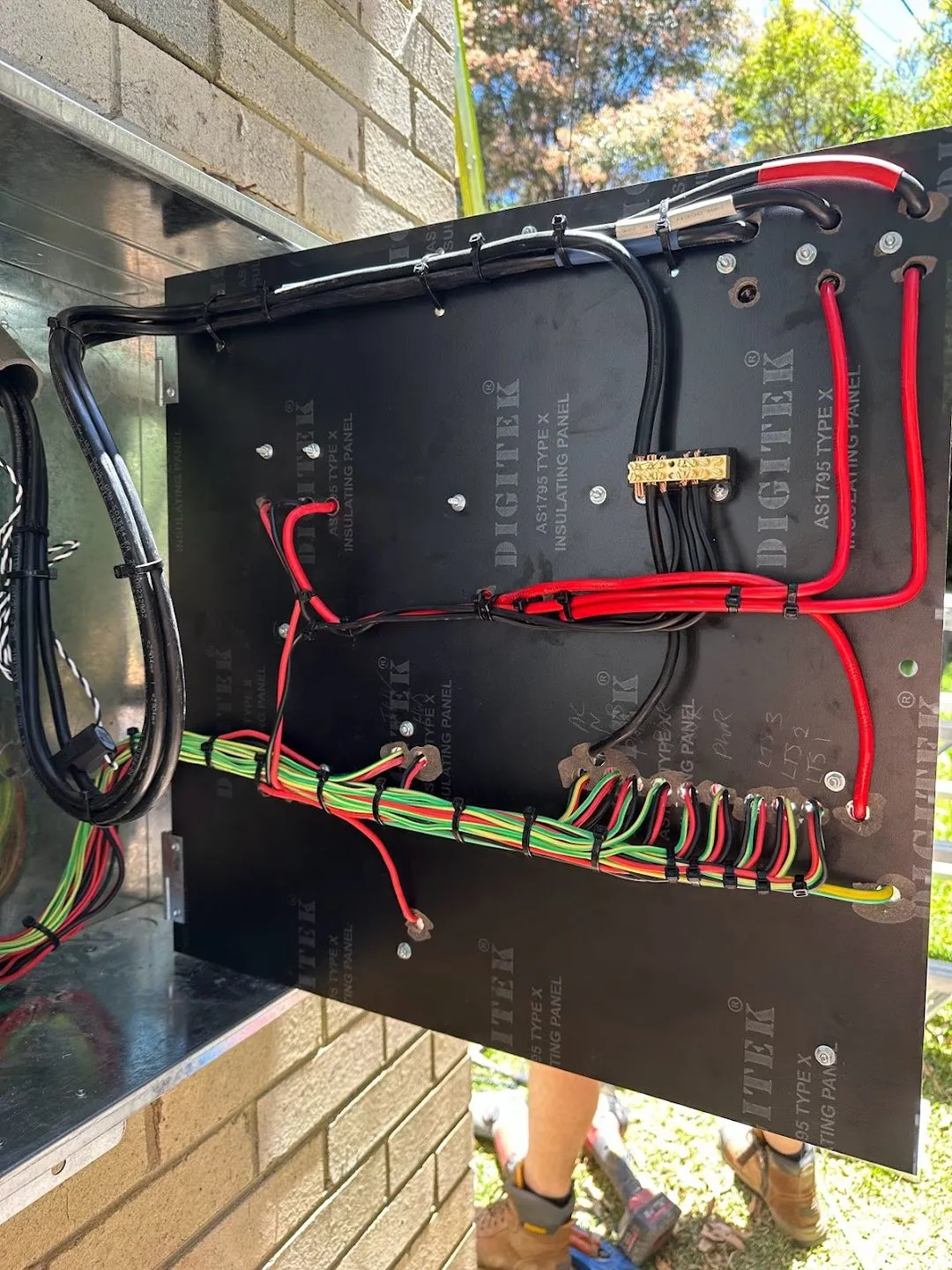
A new or relocated meter panel has to be asbestos free, with distributor metering gear kept separate from your own switchboard equipment, and mounted with proper hinge and access clearances so the enclosure can be opened safely. For Inner West terraces built well before the 1980s, this is often the real driver behind a meter box job: the existing bakelite or fibro panel is original, may contain asbestos, and simply cannot be reused once it is disturbed. We cover the same underlying housing stock issue from the switchboard side in our guide to original wiring in Federation and California bungalow terraces.
Where the enclosure is locked, a standard distributor key system has to be fitted, with any lock box mounted between 0.6m and 2.0m above ground, and the service fuse itself sits no higher than 2.0m to its top and no lower than 0.5m to its line side terminals. None of this is particularly difficult work on its own. It is getting the location right first, within the four approved options and clear of every banned one, that determines how straightforward the rest of the job actually is.
5. Narrow Terraces Without Side Access
A genuine side access problem, shared walls on both sides with zero gap, is common enough across the Inner West's terrace rows that it is worth addressing directly. When there is no usable side wall within reach of the front corner, the front facing wall itself or the front boundary fence are both valid, fully compliant fallback positions. Neither is a compromise chosen because nothing else works. They are two of the four options the rules set out from the start, which is exactly why terrace rows without side access are not actually a special case requiring a variation or an exemption, just a more limited, but still compliant, choice of where the box goes.
6. When Heritage Streetscape Rules Add Another Layer
For a property in one of the Inner West's heritage conservation areas, covering much of Balmain, Birchgrove, Rozelle, Glebe, Annandale, Leichhardt and Lilyfield, the electrical placement rules above still apply in full, but council heritage controls can add an extra layer of opinion about how visible or prominent a meter box should be on a street facing wall. We go through this council side of the equation, separate from the electrical rules, in our guide to heritage listed electrical work in the Inner West. If your property sits in a conservation area, it is worth checking both sets of rules before committing to a position, since a technically compliant location can still draw council comment if it sits prominently on a heritage facade.
Why It's Level 2 ASP Work
Relocating or replacing service equipment on a standard premises is accredited Level 2 ASP work, because it involves the network's own metering and service fuse, not just your internal switchboard. An accredited provider confirms the new position against the approved locations list, coordinates the move with the Metering Coordinator, and handles the actual disconnection and reconnection safely, rather than you discovering after the fact that a well intentioned DIY relocation needs to be redone from scratch. An independent electrical safety inspection is a good way to confirm the rest of your installation is sound at the same time.
How High Demand Electrical Helps
High Demand Electrical is a licensed local team working across the Inner West's terraces, semis and townhouses every week, not a call centre dispatching whoever is free. We know the practical side access constraints this housing stock throws up because we deal with them on real jobs, not just on paper, and we will tell you honestly which of the four approved locations actually suits your property before any quote is put together. See our switchboard upgrades if your meter box relocation is part of a wider board replacement, which it very often is once an old panel gets disturbed.
Meter Box Placement FAQs (Inner West)
Can I choose any wall I like for the meter box?
No. Only the four approved locations set out in the Service and Installation Rules of NSW are valid: the front facing wall, an adjoining side wall near that corner, a private pole, or the front boundary fence.
Does moving the meter box mean my whole switchboard needs replacing?
Not necessarily, but it is common for both to happen together, particularly on an older terrace where the existing panel is original and needs replacing anyway. See our guide to switchboard location rules for the separate rules that apply to the switchboard itself.
What if my terrace shares a wall with next door and has no side return?
The front facing wall or the front boundary fence remain valid options in that case, so a lack of side access does not require any special exemption.
Is a locked front gate a problem for the meter reader?
Only if it does not have a standard distributor locking facility fitted. Once that is in place, a locked gate in front of the meter box is fully compliant.
Does heritage listing change where the meter box can go?
The electrical placement rules stay the same, but council heritage controls can add their own view on visibility and prominence. See our heritage listed electrical work guide for how the two interact, and our electrical safety inspections for a full check of your existing setup.
Get Your Meter Box Position Checked
Get a Switchboard Upgrade Quote or call 0402 559 777 to have your meter box and switchboard position reviewed. Every job starts with a proper site assessment before scope or pricing is confirmed.
Powering Your Needs with Expertise
If you want a reliable, experienced, and prompt electrician, High Demand Electrical Inner West is the one to call. We cover every electrical need — routine maintenance, emergency repairs, full system installs — and our team is focused on keeping your setup running smoothly. Small task or big project, give us a ring today.