Running New Cable Through a Shared Party Wall? What Your Inner West Terrace Reno Needs to Know
Can you just drill through the party wall to run new cable in an Inner West terrace renovation? Not without thinking about fire separation first. The brick wall shared with your neighbour is usually a fire rated element under the building code, so any cable, conduit or switchboard penetration through it has to be sized, sealed and reinstated to keep that fire rating intact, not simply patched with gap filler.
⚡ Quick Answers: Cabling Through a Shared Party Wall
- Is the party wall between terraces actually fire rated? Usually yes. The masonry wall shared with next door is typically a fire separating wall under the building code, unlike most internal walls in your own home.
- Can I still run cable through it? Yes, but the opening has to be close fitting and size limited, and it has to be sealed back to the wall's fire rating once the cable is in.
- What size opening is allowed? AS/NZS 3000 generally limits a fire barrier penetration to 500 square millimetres, with an exception up to 2000 square millimetres for a single cable with a small gap around it.
- Does this only apply to electrical work? No. Plumbing, data cabling and ducting through the same wall need the same fire sealing treatment, which is worth coordinating across trades.
- Do I need my neighbour's permission? Routine electrical penetration work usually stays on your side of the wall, but any structural work to the party wall itself is a separate conversation with your neighbour and builder.
- Who actually seals the penetration? A licensed electrician fire seals the cable opening as part of the job, using a fire rated sealant or collar rated to the wall's fire resistance level.
1. Why the party wall is different from any other wall in your terrace
Most internal walls in your own home carry no fire rating at all, so a cable hole through them is a non issue. A terrace's party wall is different. It usually separates two separate dwellings under two separate titles, and the building code generally requires that kind of wall to resist fire spreading from one home to the next for a set period.
That fire resistance only works if the wall stays intact. Every hole cut through it for cable, conduit, a recessed switchboard or a downlight weakens that separation unless it is treated properly, which is exactly what AS/NZS 3000's rules on penetrating fire barriers are there to control.
2. What the Wiring Rules actually require
AS/NZS 3000 treats a wall that is required to be fire rated, including floors, ceilings and roofs, as a fire barrier that a wiring system is not allowed to weaken. Where a cable or conduit has to pass through one, the opening must be close fitting to the cable or conduit, kept well clear of any other service opening nearby, and limited in size, generally to 500 square millimetres, with an exception allowing up to 2000 square millimetres for a single cable that leaves only a small gap around it.
Once the cable is through, the fire rating of the wall has to be reinstated around the opening using a method suited to the degree of fire resistance the wall needs, and conduit, cable ducting or flush boxes that pass through the wall need to be internally sealed to that same fire rating, not just packed with standard gap filler or expanding foam.
Why this trips renovations up
On paper this sounds straightforward, but on site it is one of the easiest compliance steps to miss. A builder or a trade cutting a quick hole for a single cable rarely stops to check whether that wall is fire rated, or to use the correct fire rated sealant afterwards, because the hole looks the same either way until someone asks for the paperwork.
Not just an electrical problem
Plumbing, data cabling, ducted air conditioning and ventilation all cross party walls in a typical terrace renovation too, and each one needs the same fire sealing treatment where it penetrates a fire rated wall. It is worth getting your builder to coordinate all of these penetrations together rather than having several trades each cut their own hole at different stages of the job.
3. Where this actually comes up in an Inner West terrace reno
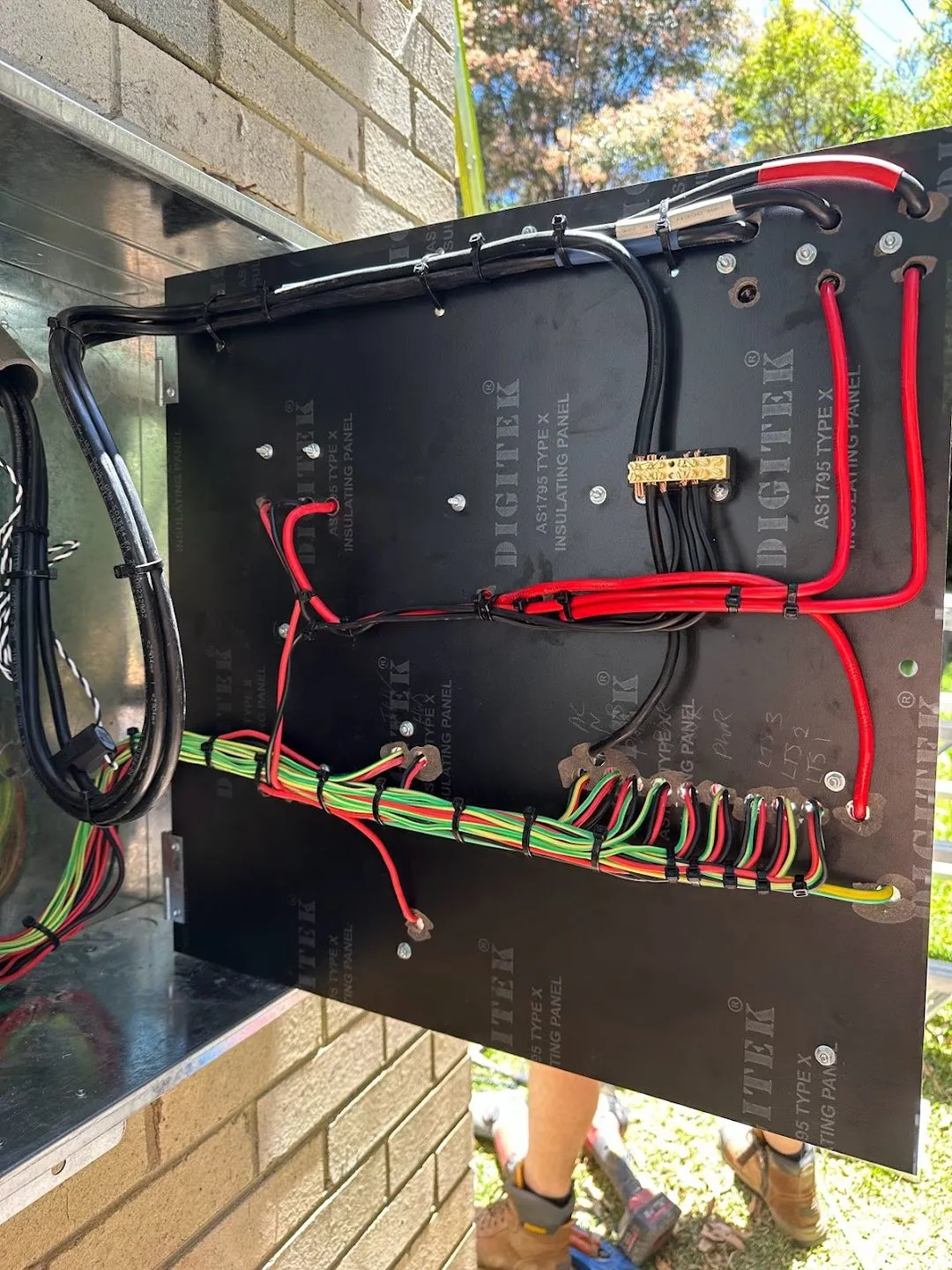
Rewiring a shared switchboard location: if the existing switchboard is recessed into or mounted hard against the party wall and the new board needs relocating, any cable run that still crosses that wall needs proper sealing. Older terraces often have an asbestos switchboard panel in exactly this spot, which is worth checking before anyone starts drilling nearby.
Kitchen or bathroom extensions: new circuits run along a party wall to reach a rear extension often need to cross it at least once, particularly in a narrow terrace where the party wall runs the full depth of the block.
Second storey additions: new lighting and power circuits feeding an upper floor commonly cross the party wall near the stair void, a detail worth flagging to your electrician at design stage rather than after the ceiling is closed up.
Data, NBN and intercom cabling: low voltage cabling still needs the same close fitting, sealed penetration treatment where it shares the same party wall as your power circuits.
4. Whose wall is it, and do you need your neighbour involved?
A party wall sits on or straddles the boundary and is shared structurally by both properties, which is a different question from who needs to approve routine electrical penetration work. Drilling a correctly sized, sealed opening for a cable run on your own side of the wall is ordinary electrical work and does not generally require your neighbour's sign off.
Structural work to the party wall itself, such as removing a section, underpinning it, or altering it as part of a second storey addition, is a separate conversation for your builder, designer and potentially your neighbour, well outside the electrical scope. If your renovation includes that kind of structural work, raise the electrical penetration points with your electrician before the wall is opened up, so the cable runs and any fire sealing are planned in rather than improvised afterwards.
5. Getting it right without slowing the job down
The fix is simple once it is on the plan. Ask your electrician to identify which walls in the renovation are fire rated party walls before cutting starts, keep cable and conduit penetrations through them to the minimum size and number genuinely needed, and use a fire rated sealant or proprietary fire collar rated to the wall's fire resistance level rather than a general purpose filler.
Builders who have done terrace renovations before usually factor this in automatically, but it is worth confirming at the trade coordination stage, particularly where plumbing, data and electrical all want to cross the same section of wall. A heritage listed property can add an extra layer of approval on top of the fire rating requirement, so check both before demolition begins. If the renovation also needs a temporary power down while the wall is opened up, our disconnect and reconnect services cover that side of the job.
How High Demand Electrical helps
High Demand Electrical is a licensed local team working across Sydney's inner west on exactly this kind of terrace renovation detail, not a call centre booking in generic tradespeople. We plan cable routes around party walls, switchboards and service penetrations before demolition starts, so your builder's program does not stall halfway through the job waiting on an electrical fix.
We also coordinate directly with your builder and other trades where several services need to cross the same party wall, and we can advise on switchboard upgrades where relocating the board away from a party wall solves several problems at once. Where a renovation also touches the point of attachment or meter, see our guide on when a renovation requires the point of attachment or meter to move, and our sister company covers the same kind of careful trade coordination on general Level 2 and ASP jobs through its Level 2 electrician services across the rest of Sydney, including its own guide to splitting a shared switchboard in an older semi.
Party Wall Cabling FAQs (Sydney)
Is every wall between terraces fire rated?
Most shared party walls between separate terrace titles are fire rated under the building code, but construction varies, particularly in older or heavily altered terraces. Your electrician or builder can confirm the wall's construction and rating before any penetration work starts.
What happens if a penetration isn't sealed properly?
An unsealed or incorrectly sealed penetration weakens the wall's ability to contain a fire, which can be picked up at a building inspection, an insurance assessment, or a later electrical safety inspection, and may need to be reopened and resealed correctly.
Can I use normal gap filler or expanding foam instead?
No. A fire rated wall penetration needs a sealant or fire collar specifically rated to that wall's fire resistance level, not a general purpose builder's filler, which offers no meaningful fire resistance once the wall is compromised.
Does this apply to a single storey terrace as well as a two storey one?
Yes. The fire rating requirement depends on the wall's construction and its role separating two dwellings, not on how many storeys the terrace has, so a single storey renovation still needs the same sealing treatment.
Should I mention this to my builder before demolition starts?
Yes. Flagging party wall penetrations at the planning stage, alongside consumer mains and switchboard positions, avoids a trade cutting an oversized or unsealed hole that then has to be redone.
Get a Renovation Electrical Quote or call High Demand Electrical on 0402 808 808. Every renovation job needs a site assessment before we can confirm scope or price, especially where party walls, switchboards and service penetrations all need to be planned together.
Powering Your Needs with Expertise
If you want a reliable, experienced, and prompt electrician, High Demand Electrical Inner West is the one to call. We cover every electrical need — routine maintenance, emergency repairs, full system installs — and our team is focused on keeping your setup running smoothly. Small task or big project, give us a ring today.

Licensed Level 2 ASP electricians across the Inner West and Sydney. Same-day service and 24/7 emergency response.
Licence 397193C
ABN 87 051 836 527