Solar Installation in Leichhardt
Need a trusted solar installation service in Leichhardt? High Demand Electrical provides expert solar installation services across Leichhardt and the wider Inner West region. Our fully licensed Level 2 ASP electricians deliver safe, compliant and professional work every time.
We regularly work in Leichhardt and neighbouring Annandale, Lilyfield and Haberfield, so we know the local housing stock and the Ausgrid network that supplies it.
- NSW Licence 397193C
- Level 2 ASP accredited
- Ausgrid connection paperwork handled
- Solar, batteries & switchboards
Solar for Leichhardt Homes and Businesses
Leichhardt is known for its Victorian terraces, Federation homes and the Norton Street and Parramatta Road shopping strips with their strong Italian heritage.
Victorian terraces and Federation homes have a mix of small rear roofs and larger hipped roofs, with some streets in heritage conservation areas.
Local tip: Older homes often need switchboard work before solar can be connected, so we inspect the board at the same visit.
Every system we quote starts with your roof, your switchboard and your power bills, not a pre-set package. We look at roof orientation and pitch, shading through the day, roof material and condition, access, and whether your switchboard and meter can take a solar connection safely.
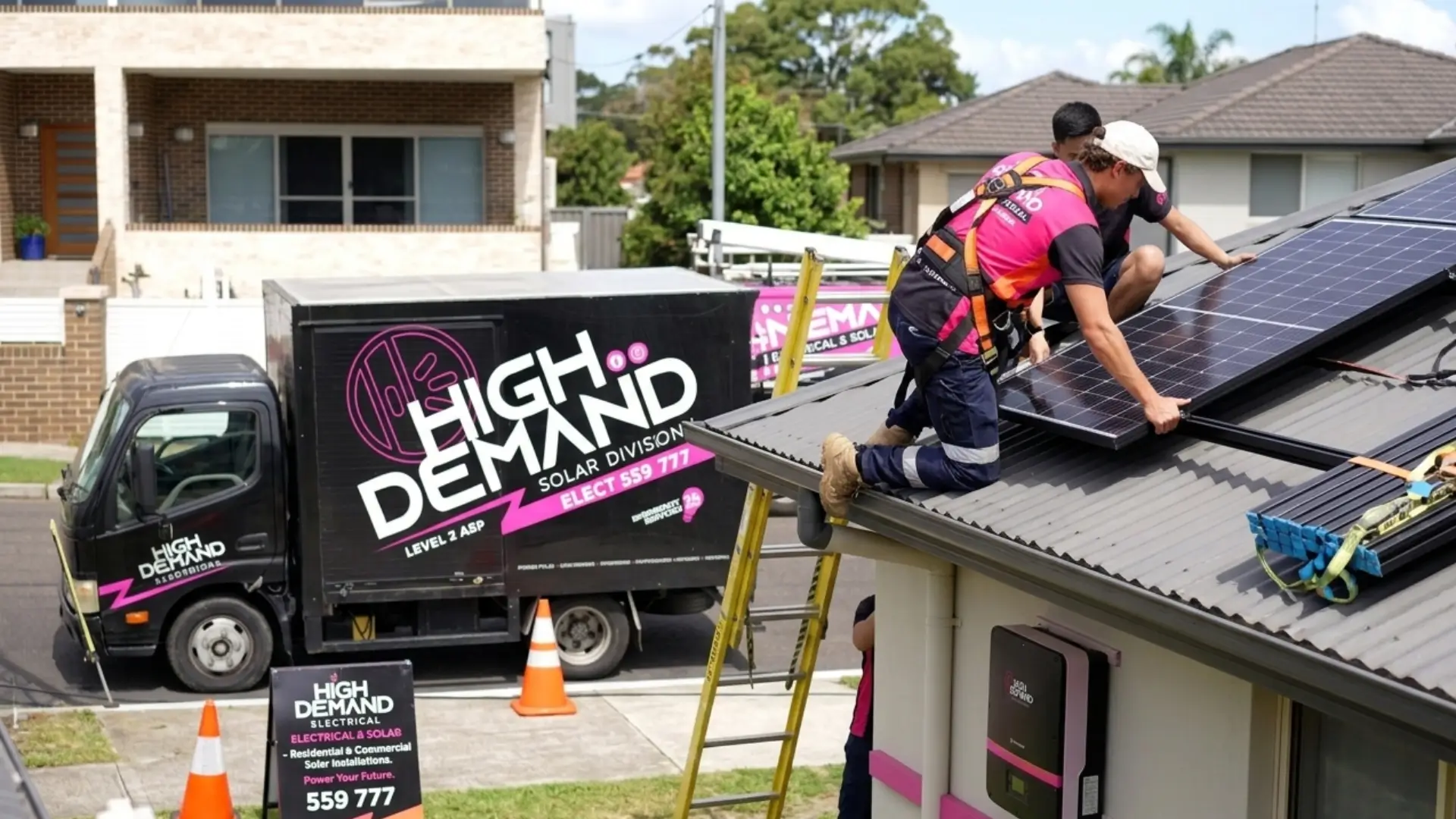
Solar Installation Services
Solar, battery and the electrical work around them, done by the same licensed team.
Residential solar systems
Grid-connected rooftop systems designed around your roof space, shading and daily power use.
Solar battery installation
Batteries added with new solar or retrofitted to an existing system. See our solar battery guide page.
Commercial solar
Systems for shops, offices, studios and warehouses, sized from your bills or measured demand.
Switchboard and metering work
Board upgrades, isolators and Level 2 service work needed to connect solar safely. See switchboard upgrades.
System expansions and inverter replacement
Adding panels, replacing a failed inverter or upgrading to a battery-ready hybrid inverter.
Inspections and fault finding
Checking an existing system that is underperforming, tripping or showing inverter errors.
How a Grid-Connected Solar System Works
Most Sydney homes use a grid-connected system: your panels power the house first, and the grid fills any gap.
Panels generate DC power
Solar panels on your roof turn sunlight into direct current (DC) electricity.
The inverter converts it
The inverter converts DC into alternating current (AC) that your home can use, and manages the connection to the grid.
Your home uses it first
Solar power goes to whatever is running in the house at the time, reducing what you buy from the grid.
Excess is exported or stored
Unused solar is exported to the grid for a feed-in credit from your retailer, or stored in a battery if you have one.
For safety, a standard grid-connected inverter shuts down during a blackout so it cannot send power into the network. Backup power needs a battery and a backup-capable inverter set up for it. Read what happens to solar in a blackout.
What Size Solar System Do You Need?
System size is measured in kilowatts (kW) of panels. The right size depends on how much power you use, when you use it, and how much usable roof you have.
*Based on panels of roughly 400 to 450 watts each. Actual panel numbers depend on the panel model and the roof layout.
How much does a system produce?
As a rough guide, a well-oriented, unshaded system in Sydney averages around 3.5 to 4.5 kWh per day for each kW of panels across a year. Winter output is lower and summer output is higher.
Inverter sizing
Panels are often sized above the inverter rating, for example 6.6 kW of panels on a 5 kW inverter, within the limits allowed by the rules for the STC scheme and the inverter maker.
Export limits
Ausgrid sets how much power your system may export. Larger systems may be export limited, which affects sizing. Read about export limiting and zero export.
Inverters and Batteries Explained
The inverter you choose affects shading performance, monitoring and whether a battery can be added later.
String inverter
One central inverter for the array. Cost-effective on simple, unshaded roofs facing one or two directions.
Microinverters or optimisers
Panel-level electronics that limit the effect of shade on one panel and suit split or partly shaded terrace roofs. They usually cost more.
Hybrid inverter
Manages panels and a battery together. A good choice if you want a battery now or plan to add one later.
Do you need a battery?
No. Solar works without a battery, and many homes get good value by using more power during the day. A battery stores excess solar for the evening and can provide backup power if the system is designed for it.
A battery tends to suit homes with high evening use, low feed-in credits or a need for blackout backup. Battery installation must meet AS/NZS 5139, which controls where a battery can be located, so we check suitable locations at the site visit. If you are unsure, power logging can show how and when you actually use power.
Batteries without new solar
You can add a battery to an existing solar system, or install a grid-charged battery on its own. See home batteries without solar and solar and batteries on terrace roofs.
What Affects Solar Performance
Orientation
North-facing roofs give the most total output. East and west roofs still work well and can match morning or afternoon use.
Shading
Trees, chimneys, parapets and neighbouring buildings can cut output. Inverter choice and panel layout can reduce the impact.
Roof pitch and type
Tin, tile, slate and flat roofs each need different mounting. Flat roofs may need tilt frames.
Heat
Panels lose some efficiency in high temperatures, so summer output is not as high as the extra daylight suggests.
Equipment quality
Panel and inverter efficiency, and how well the system is installed and wired, affect output over its life.
Export limits
If your site has an export limit, some generation may be curtailed when the house is not using it.
What Solar Costs and What It Can Save
We don't publish one-size-fits-all prices because the cost depends on your roof and switchboard. You get a written, itemised quote after a site assessment.
What affects the price
- System size, panel brand and inverter type
- Roof material, pitch, height and access
- Number of roof faces and cable run length
- Switchboard, isolator or metering upgrades
- Adding a battery now, or making the system battery-ready
- The current value of STCs for your system
How savings work
- Every kWh of solar you use yourself is a kWh you don't buy from the grid. This is usually where most of the value comes from.
- Exported solar earns a feed-in credit, which is usually much lower than the price you pay for grid power.
- Shifting use into daylight hours, such as running the dishwasher, pool pump or EV charger in the day, increases savings.
- Your retailer's tariffs and any network charges affect the result, and they can change.
Savings and payback vary from home to home and are not guaranteed. Any estimate we give you is based on your bills and stated assumptions, so you can see how it was worked out.
Solar and Battery Incentives in NSW
Incentives change regularly. We show the current value on your quote, and you can check the latest details with the government sources linked below.
Small-scale technology certificates (STCs)
Under the federal Small-scale Renewable Energy Scheme, eligible solar systems create STCs that reduce the upfront price. The number of certificates reduces each year until the scheme ends in 2030, and their dollar value moves with the market. Visit the Clean Energy Regulator.
Cheaper Home Batteries Program
A federal discount on eligible home batteries installed with new or existing solar, also delivered through STCs. The discount depends on battery capacity and is scheduled to reduce over time. Check current details at energy.gov.au.
NSW battery and VPP incentives
Under the NSW Peak Demand Reduction Scheme, households may receive an incentive for connecting an eligible battery to a virtual power plant (VPP). Amounts and eligibility vary. See energy.nsw.gov.au.
Eligibility rules apply to all of these, including approved products and accredited design and installation. Incentives are separate from, and do not replace, product warranties or our workmanship warranty.
Understanding Solar Warranties
A solar system has several separate warranties from different parties. Your quote lists each one.
Manufacturer warranties are claimed through the manufacturer, and we can help you with the process. Australian Consumer Law guarantees apply as well.
Standards and Approvals for Solar in NSW
A compliant solar installation in NSW involves several standards, approvals and parties. Here is what applies to a typical home system.
- AS/NZS 3000 (the Wiring Rules) for all electrical work.
- AS/NZS 5033 for the design and installation of the solar array.
- AS/NZS 4777 for connecting inverters to the grid and how they respond to network conditions.
- AS/NZS 5139 for battery system installation and location.
- Ausgrid connection application and approval before the system is connected.
- Certificate of Compliance for Electrical Work (CCEW) lodged for the work, as required in NSW.
How Solar Installation Works With Us
Enquiry and bills
Tell us about your home and send a recent power bill so we can see your usage.
Site assessment
We check the roof, shading, switchboard, meter and possible battery locations.
Design and written quote
You get a system design, itemised price, STC value and warranty details.
Network application
We lodge the Ausgrid connection application and confirm any export limit.
Installation
Most home systems are installed in a day, with switchboard work done at the same time.
Testing and handover
We test and commission the system, lodge compliance paperwork and show you the monitoring.

Solar Maintenance and Lifespan
Solar needs little maintenance, but it is not set-and-forget.
- Check your monitoring app regularly. A sudden drop in output is the first sign of a fault.
- Rain usually keeps panels clean enough. Heavy dirt, bird droppings or leaf build-up may need a professional clean. Don't climb on the roof yourself.
- Have the system inspected periodically, including DC isolators, cabling and mounting, as recommended by the manufacturers.
- Panels commonly last 25 years or more. Inverters usually need replacing sooner, often within 10 to 15 years.
Older system underperforming? We can inspect it and advise on repair, inverter replacement or expansion. An older switchboard may also need a switchboard upgrade before new equipment is added.
Electricians First, Then Solar
Solar is electrical work. We handle the roof, the switchboard and the network side as one licensed team.
Level 2 ASP accredited
We can do the service and metering work a solar connection sometimes needs, without waiting for another contractor.
Licensed in NSW
NSW electrical contractor licence 397193C.
New Energy Tech Approved Seller
We are an Approved Seller under the New Energy Tech Consumer Code.
Switchboard to roof
Switchboard upgrades, consumer mains, three phase upgrades and smart meters when your site needs them.
Planned for what's next
We can allow for a battery or EV charger in the design so you don't pay twice later.
Certified systems
ISO 9001, ISO 14001 and ISO 45001 certified management systems, and a NECA member.
Solar Installation FAQs
How much does solar installation cost in Leichhardt?
It depends on system size, panel and inverter choice, roof type and access, any switchboard or metering work, and whether a battery is included. Eligible systems can receive small-scale technology certificates (STCs), which reduce the upfront price, and the value changes over time. We give you a written, itemised quote after a site assessment. Call 0402 808 808 to book one in Leichhardt.
How many solar panels do I need?
Divide the system size you need by the panel wattage. A 6.6 kW system uses around 15 to 16 panels of 420 to 440 watts. Your usage and usable roof area decide the final number.
What size solar system do I need?
Start with your daily usage on your power bill and how much of it happens in daylight. Many Sydney homes install 6 to 10 kW, but the right size depends on roof space, budget, export limits and any plans for a battery or EV.
Is solar worth it?
For many homes that use a good share of their power during the day, yes. Value depends on your usage pattern, tariffs, feed-in rate and roof. We show the assumptions behind any estimate so you can judge it yourself.
How long does installation take?
Most home systems are installed in one day. Time from quote to switch-on depends on network approval and equipment availability.
Do I need a battery with solar?
No. A battery is optional. It can help if you use a lot of power at night or want blackout backup. A hybrid inverter lets you add one later.
What rebates or incentives are available?
Eligible solar systems receive STCs under the federal scheme, eligible batteries can get a discount under the Cheaper Home Batteries Program, and NSW offers incentives for connecting batteries to a VPP. Values change, so your quote shows the current amount.
How long do solar panels last?
Quality panels commonly last 25 years or more, with output reducing slowly over time. Inverters usually need replacing sooner.
Does solar work during a power outage?
Not on its own. A standard grid-connected system shuts down in a blackout for safety. You need a battery and backup-capable inverter, set up with backup circuits, to keep power on.
Do solar panels need maintenance?
Very little. Watch your monitoring, keep panels reasonably clean and have the system inspected periodically as the manufacturers recommend.
Who approves a solar connection in Leichhardt?
Leichhardt is supplied by Ausgrid. Before a system is connected, a connection application is made to Ausgrid, which can set export limits for your site. We handle the application and paperwork, and your retailer arranges any meter changes needed for feed-in.
Do you also install solar near Leichhardt?
Yes. As well as Leichhardt, we install solar in nearby Annandale, Lilyfield and Haberfield, and across the wider Inner West. Call 0402 808 808 to check availability.
Solar Installation Across the Inner West
Find solar installation information for your suburb.
Get a Solar Quote Based on Your Home
High Demand Electrical delivers professional solar installation services across Leichhardt and the wider Inner West region. Contact us today on 0402 808 808 for a free quote.
Send us a recent power bill and a few details about your roof. We'll book a site assessment and give you a clear, itemised written quote.
Our Partners


Powering Your Needs with Expertise
If you want a reliable, experienced, and prompt electrician, High Demand Electrical Inner West is the one to call. We cover every electrical need — routine maintenance, emergency repairs, full system installs — and our team is focused on keeping your setup running smoothly. Small task or big project, give us a ring today.

Licensed Level 2 ASP electricians across the Inner West and Sydney. Same-day service and 24/7 emergency response.
Licence 397193C
ABN 87 051 836 527